
Knowing your daily calorie intake can help you stay on track for the right amount of calories you need in a day, plan your meals and support your fitness. Since age, heights, weights, activity type and purpose will vary among people, the daily calorie requirement is different for each person.
The use of a single calorie target isn’t helpful; a better starting point is to estimate individual needs. A calculator may be used but only as an approximation and not as a requirement.
What Is Daily Calorie Intake?
Daily calorie intake is the amount of calories you consume throughout the day. Calories power your body to function normally, including for moving, exercising, digesting, and everyday living.
If you are unsure about how many calories should I eat, it varies depending on your personal needs and your goals (to lose weight, to gain weight, or to maintain fitness).
As your weight, activity level, and goals vary, so do your daily calorie intake requirements.

How to Calculate Your Daily Calorie Intake
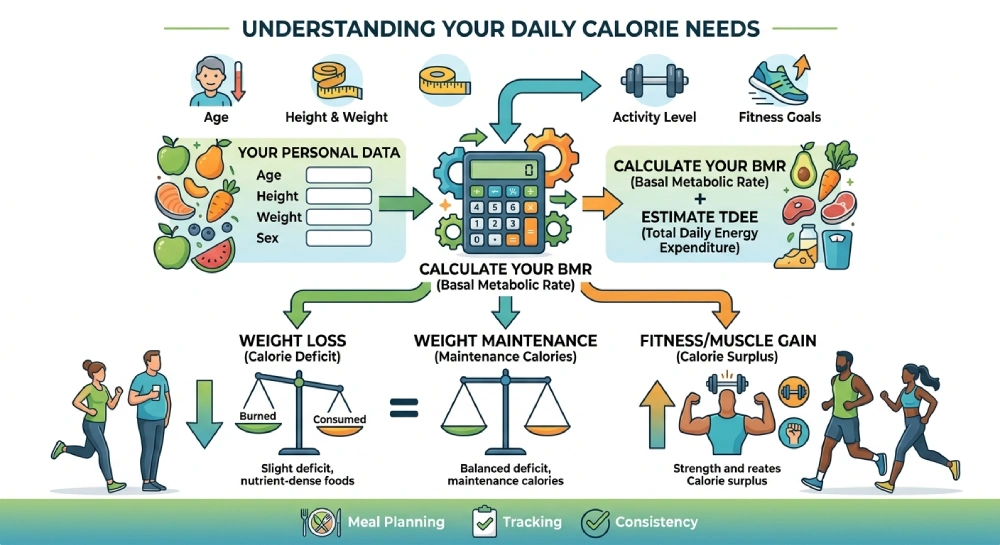
Calorie estimation, or BMR calculation, is the first step in understanding how to calculate calories. This is the amount of energy that your body consumes while sitting and resting.
The amount of activity you perform then determines your total daily energy expenditure. This will give you an idea of the amount of energy that you might require to keep your weight the way it is.
A daily calorie intake calculator is able to do these calculations based on:
- Age
- Height
- Weight
- Activity level
A calorie intake calculator is helpful to get a ballpark estimate without having to perform the calculations yourself.
How Many Calories Should I Eat to Lose Weight?
Calories to lose weight is a question that is usually answered with a calorie deficit, that is, eating less than what the body needs.
But the amount of calories you need to cut is different for each person. A very large reduction is not necessarily good and may make it more difficult to obtain adequate nutrition or energy.
Therefore, the number of calories per day to lose weight is likely to be related to estimated calorie requirements, individual factors, and a realistic plan.
How to Calculate a Calorie Deficit
A calorie deficit is when you consume less calories than your body expends.
The first step to know how to calculate calorie deficit is to estimate your maintenance calories. A moderate amount of that can then give an approximation of an acceptable weight loss goal.
If you want to know how to work out calorie deficit, the basic concept is:
Calorie deficit = maintenance calories – food calories
For instance, a person’s estimated calorie needs are 2200 calories a day and he consumes 1900 calories daily, meaning that he has an estimated deficit of 300 calories per day.
Can a Calories Calculator Help You Estimate Your Needs?
A calories calculator can help to estimate calories using your personal data to suggest a ‘target’ calorie amount for the day.
Some calorie calculators for weight loss will also calculate an approximate calorie goal for a specific amount of weight loss. But these tools will not match the metabolism, activity or body composition of every individual with precision.
Use the answer from the calculator as a base and modify as needed according to real-life progress and needs.
What Factors Affect Your Daily Calorie Needs?
Several factors influence daily calorie intake, so two people of the same age and weight may still need different amounts.
The main factors include:
- Age: Calorie needs can change as you get older.
- Height and weight: Larger bodies generally require more energy.
- Activity level: Exercise and daily movement increase energy use.
- Muscle mass: Muscle tissue contributes to energy expenditure.
- Goals: Weight loss, maintenance, and muscle building may require different calorie targets.
This is why asking how much calories do I need cannot be answered accurately with one number for everyone.
How Can You Track Your Daily Calorie Intake?
You can use tracking to get a better understanding of the amount of energy you’re using while eating. A food label, portion control, food tracking apps and food record books of any kind might be helpful.
Calorie intake calculator and tracking can help to set a target and then track the amount of calories you’re actually getting.
There is no need for perfection when it comes to accuracy. When food intake is accurately monitored and documented over time, it can give a better sense of awareness of portions.
Common Mistakes When Calculating Calorie Needs
When learning how to calculate calories, it is easy to make assumptions that affect the final estimate.
Common mistakes include:
- Overestimating exercise calories
- Treating calculator results as exact
- Underestimating portion sizes
- Creating an overly aggressive calorie deficit
- Forgetting that calorie needs can change
- Focusing only on calories instead of overall nutrition
A calorie calculator to lose weight is most useful when its results are treated as a starting estimate rather than a fixed rule.
Conclusion
Assessing how many calories an individual consumes per day can assist them in making healthier food choices, managing their weight, and getting fit. There is no single number to apply to everyone, as calorie requirements vary based on a number of factors.
Start with a daily calorie calculator or a calories calculator to get a baseline, and then review progress, activity, goals and nutrition to see if changes are necessary.
Frequently Asked Questions
How much calories do I need to maintain my weight?
A calorie calculator can help give an estimate, but you may require more or less than the calculated amount.
How many calories should I eat to lose weight?
Typically, weight loss involves burning more calories than you are taking in. People vary in their appropriate level of deficit, so it is more realistic to have a moderate and sustainable deficit than an extreme one.
How do I calculate my daily calorie intake?
Obtain a ballpark estimate of BMR by using the factors of age, height, and weight, and then take into account your activity level to get an estimate of your total daily energy expenditures. This can be streamlined with a calculator.
What is a calorie deficit?
When you have a calorie deficit you are taking in fewer calories than you burn. Maintaining a negative energy balance over time can result in weight loss, but may not work for everyone.
How do I calculate a calorie deficit?
Calculate how many calories you need for maintenance. Then subtract the number of calories you want to lose from the above number. For instance, if the maintenance calories are 2,200 and the calories burned are 300, then the estimated deficit is 300 calories.
Can a calorie calculator help me lose weight?
The calorie calculator for loss of weight can be helpful as an initial estimate based on your personal details. It cannot guarantee an exact outcome due to variations in energy output and metabolism of individual people.
How many calories per day should I eat to lose weight?
No standard calorie value for each person to lose weight. The exact amount needed is dependent on your current energy requirements, body size, activity level, targets, and the amount of calories that you are deficit.
Does exercise change my daily calorie needs?
Yes. The amount of calories required can be influenced by exercise and other physical activity. Therefore, your guessed number of calories may need to be changed when activity levels change.
Is a daily calorie intake calculator accurate?
A calorie calculator program for daily consumption does not give an exact amount. It may help set a starting point for a calorie goal but different people may require varying amounts of calories.